Understanding the Employee Lifecycle: A Manager's Guide to Every Employee Lifecycle Stage



Most managers don't lose employees the moment they hand in their resignation. They lose them months earlier, at a missed development conversation, a flat onboarding week, a recognition moment that never came. By the time someone hands in their notice, the decision is usually well baked.
That's why the employee lifecycle matters. Understanding where each of your employees sits in their journey with your company, and meeting them at that stage, is one of the most underrated levers a manager has. It's also one of the most expensive to ignore. SHRM's 2025 Benchmarking Report puts the average cost-per-hire at $5,475 for non-executive roles and $35,879 for executive positions, and that's before you count the productivity dip, the team disruption, and the institutional knowledge that walks out the door.
This guide walks through what the employee lifecycle is, the stages that make it up, and most importantly, what to do differently at each one.
What Is the Employee Lifecycle?
The employee lifecycle is the full arc of someone's relationship with a company, from the moment they first hear your name to long after they've left. It's the HR equivalent of the customer journey: a framework for understanding that the person sitting in your Tuesday standup has different needs than the person you're interviewing on Thursday, even if they're doing the same job. A lifecycle mindset is honest and useful: every employee will eventually leave, and your job is to make the stretch in between as valuable for them as it is for you.
What Are the Stages of the Employee Lifecycle?
There's no single official model. Different HR frameworks may slice it into anywhere from six to twelve stages. Here's the version that captures the most useful distinctions, grouped into three broader phases so it's easier to think about.
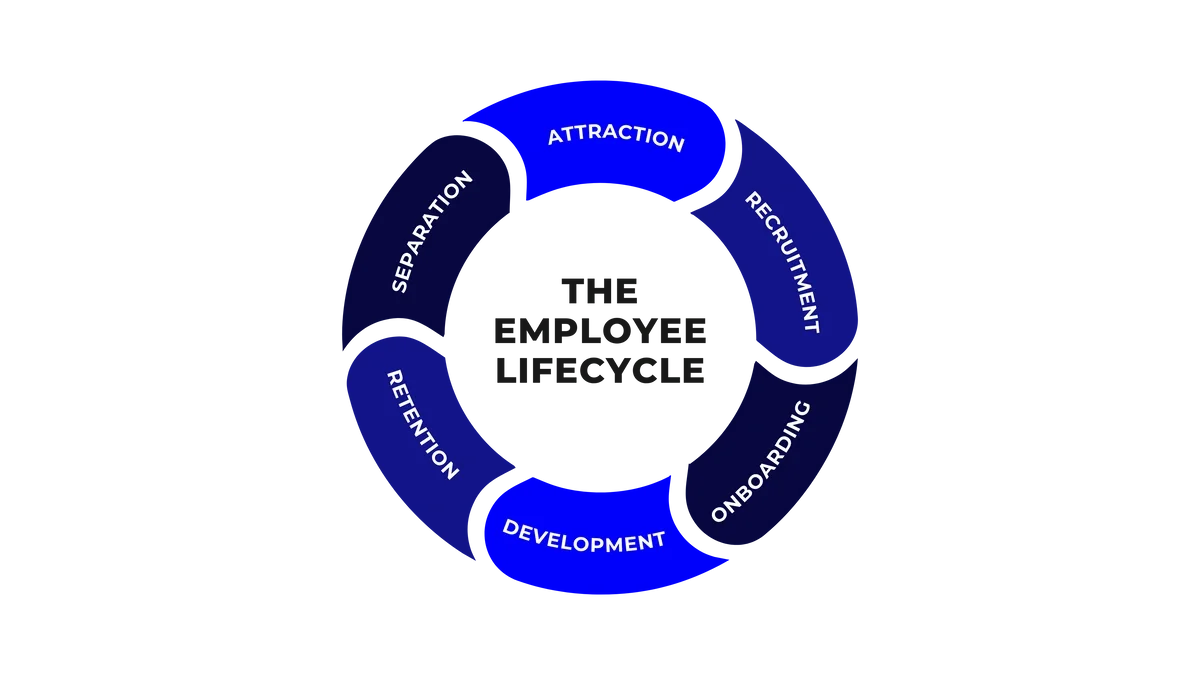
Phase 1: Joining your company
-
Attraction: How candidates discover you. Your employer brand, job descriptions, social presence, and reputation all live in this lifecycle stage. A candidate forms an opinion before they ever click "apply."
-
Recruitment: The process of attracting applicants and moving them through your pipeline. Speed, communication, and clarity make or break this stage.
-
Interviewing: The two-way evaluation. The candidate is interviewing you just as hard as you're interviewing them, especially in a tight talent market.
-
Onboarding: The first 90 days. If you get this stage wrong you might already lose them: research from SHRM found that 20% of first year turnover happens within the first 45 days.
Phase 2: Working at your company
-
Engagement: This is about day-to-day relationships and getting into the groove of working. Gallup's data shows only around 20% of employees globally are engaged at work, meaning the other 80% represent both your biggest risk and your biggest opportunity.
-
Development: Growth, learning, and advancement. Lack of career development is among the top reasons employees leave.
-
Recognition: Whether people feel seen for the work they do. This isn't the same as pay. Engaged employees who feel recognized are less likely to leave than those who do not feel recognized
-
Retention: The cumulative result of getting the stages above right.
Phase 3: Leaving and beyond
-
Offboarding: The mechanics of departure. Knowledge transfer, handoffs, the last two weeks.
-
Separation: The actual exit, including the exit interview. This is where you learn what the lifecycle felt like from that employee’s standpoint.
-
Alumni: Former employees as a network. They can refer talent to your org, return as boomerang hires, or send business your way, but only if they left on good terms.
What Is the Employee Lifecycle Model, and Why Does It Matter?
A lifecycle model is just a structured way of thinking about all of this, a map you can use to figure out where your weak spots are. The point isn't to memorize the stages; it's to use them diagnostically.
Here's what makes the model valuable: it surfaces problems you'd otherwise miss. Most managers focus on the dramatic stages. Recruiting and offboarding bookend everyone's attention. But the quietest stages, engagement and recognition, are where the most preventable turnover happens. Many employee exits are driven by career stagnation, weak management, and recognition gaps that compound over months and are addressable.
The lifecycle model turns "she just quit out of nowhere" into "we missed three development conversations and never followed up on the feedback she gave in her one-year review." That's a problem you can fix.
How to Improve Employee Retention at Every Lifecycle Stage
Retention isn't a single program and there’s no one size fits all situation. It's the byproduct of doing the right things at each stage. Here are few ideas for what that looks like in practice:
-
At attraction and recruitment: Be honest about the role. Glossy job descriptions that oversell create new hires who feel deceived by month three. Specificity attracts the right people and filters out the wrong ones.
-
At onboarding: Structure beats enthusiasm. Companies with formal onboarding programs will see higher retention. A documented 30/60/90-day plan matters more than a welcome lunch.
-
At development: Make growth conversations recurring, not annual. The employees who leave for "more opportunity" almost always left mentally before they left physically, and they usually told someone, or at least tried to.
-
At recognition: Specific beats generic. "Great job this quarter" is forgettable. "The way you handled the migration on Friday saved us a week" is the kind of moment people remember when a recruiter calls.
-
At offboarding and alumni: Treat the exit interview as your most important market research. People leaving have nothing to lose by being honest, and what they tell you is a free roadmap for fixing the lifecycle for everyone still there.
Here’s some good news: each step compounds, so strong onboarding makes engagement easier. Good engagement makes development conversations natural. Active development makes retention almost passive. The companies that struggle with retention usually have a weak link somewhere upstream they haven't diagnosed.
Where to Start Right Now
If you only do one thing after reading this, do this: pick one stage where you suspect you're weakest, and pick one employee currently in that stage. Have a real conversation with them about it. The lifecycle framework is useful, but it's the conversations it prompts that move retention numbers.
Other Ideas on How to Build an Inclusive Lifecycle That Retains More Talent.
A truly effective employee lifecycle doesn't just retain employees, it works for all employees. CareerCircle helps employer partners build hiring and retention practices that reach talent often overlooked by traditional pipelines, including job seekers with disabilities and veterans.
Like we said, there’s no one size fits all model, but we have some free resources like the "Understanding the Candidate Experience for Job Seekers with Disabilities Guide for practical steps you can apply at the attraction, recruitment, and onboarding stages of your lifecycle for the disability community.
Ready to talk through your employer partnership? Reach out today!
Content Contributor:
Jenny Han contributed to this content and is a writer for Write My Dissertation and Buy Dissertation. She covers business management and advancement, helping business owners find success. She is also a blogger at Do My Assignment.